
Scaling Up: Why Your Business Needs Retail ERP Software Development
Scaling your retail business from three to ten storefronts is an exciting milestone, but it’s also where operational complexity typically skyrockets. Disconnected online and offline orders, scattered inventory data, misaligned supplier coordination, and sluggish reporting make expansion incredibly challenging.
This hurdle cannot be overcome by simply patching another standalone tool into your tech stack. Instead, investing in professional retail ERP software development has become an operational imperative. A custom ERP doesn’t just centralize varied business functions; it democratizes real-time data access for all your internal teams.
According to Fortune Business Insights, the retail and eCommerce sectors account for nearly 14% of all ERP software development. Their reports indicate a massive surge in supply chain, customer engagement, and personalization solutions as retailers aggressively leverage analytics and automation to maximize efficiency.
If you are evaluating your options for retail ERP software development, this comprehensive guide covers everything you need to know. We will explore the types, must-have features, business benefits, development costs, and the best practices required to guarantee a seamless post-deployment run.
Key Takeaways
- Retail expansion is severely hindered when sales, finance, inventory, and customer data are isolated in silos.
- A custom retail ERP establishes a “single source of truth,” seamlessly connecting every sales channel and retail operation.
- Selecting the correct feature set and ERP architecture is just as critical as the software development process itself.
- Implementing a phased rollout strategy significantly lowers deployment risks and boosts organizational user adoption.
- The true ROI of retail ERP software development lies in data-driven decision-making, long-term scalability, and maximized operational efficiency.
What Is Retail ERP Software?
As Forbes explains, an ERP (Enterprise Resource Planning) is a specialized software ecosystem designed to unify diverse workflows into a single interface. For the retail industry, core components typically include Point of Sale (POS), inventory control, order fulfillment, financial tracking, and Customer Relationship Management (CRM).
By breaking down data silos, a custom-built retail ERP solution provides real-time operational visibility. It streamlines manual workflows and empowers retailers to make data-backed decisions across both physical storefronts and digital channels.
6 Types of Retail ERP Software Architecture
Retail ERP solutions come in several distinct architectures, catering to varying business sizes, security needs, deployment preferences, and budgets. While cloud-based systems offer unmatched scalability, on-premises setups provide ultimate control. Here is a breakdown of the six primary types of ERP for the retail industry:
| Retail ERP Type | Best Suited For | Key Advantages | Crucial Considerations |
|---|---|---|---|
| Cloud-based Retail ERP | SMBs, rapidly growing retailers, multi-location businesses | Minimal upfront costs, easy scalability, automatic updates, remote access | Requires continuous internet connectivity and ongoing subscription fees |
| On-premises Retail ERP | Large-scale enterprises with stringent security/data requirements | Total data governance, advanced customization, elite security | Higher initial implementation, maintenance, and infrastructure costs |
| Hybrid Retail ERP | Brands transitioning from legacy tech or managing diverse physical locations | Merges cloud agility with on-premises security; ideal for gradual modernization | System management and integrations can be highly complex |
| Industry-specific Retail ERP | Fashion, grocery, pharmacy, electronics, or furniture sectors | Niche-specific workflows (e.g., expiry tracking for groceries), faster deployment | Can lack flexibility if the business expands outside its original niche |
| Open-source Retail ERP | Companies with robust in-house tech teams | Zero licensing fees, deep development flexibility, high customization | Demands continuous in-house maintenance, security patching, and technical support |
| Custom-built Retail ERP | Retailers with complex operations, rapid growth, and unique workflows | Tailor-made features, limitless scalability, seamless API integrations, competitive edge | Requires a higher initial capital investment and a longer development lifecycle |
Pro Tip: While standard cloud or on-premises solutions work well for basic operations, retailers aiming to deliver a truly flawless omnichannel customer experience inevitably see the highest ROI from a custom-built solution crafted through professional retail ERP software development.
Why Retail Businesses Invest in Custom Retail ERP Software Development
Managing an expanding retail footprint becomes a logistical nightmare when systems cannot communicate with each other. A custom ERP software for the retail industry transforms chaos into harmony. Here are the distinct benefits that drive maximum ROI:
1. Seamless Omnichannel Operations
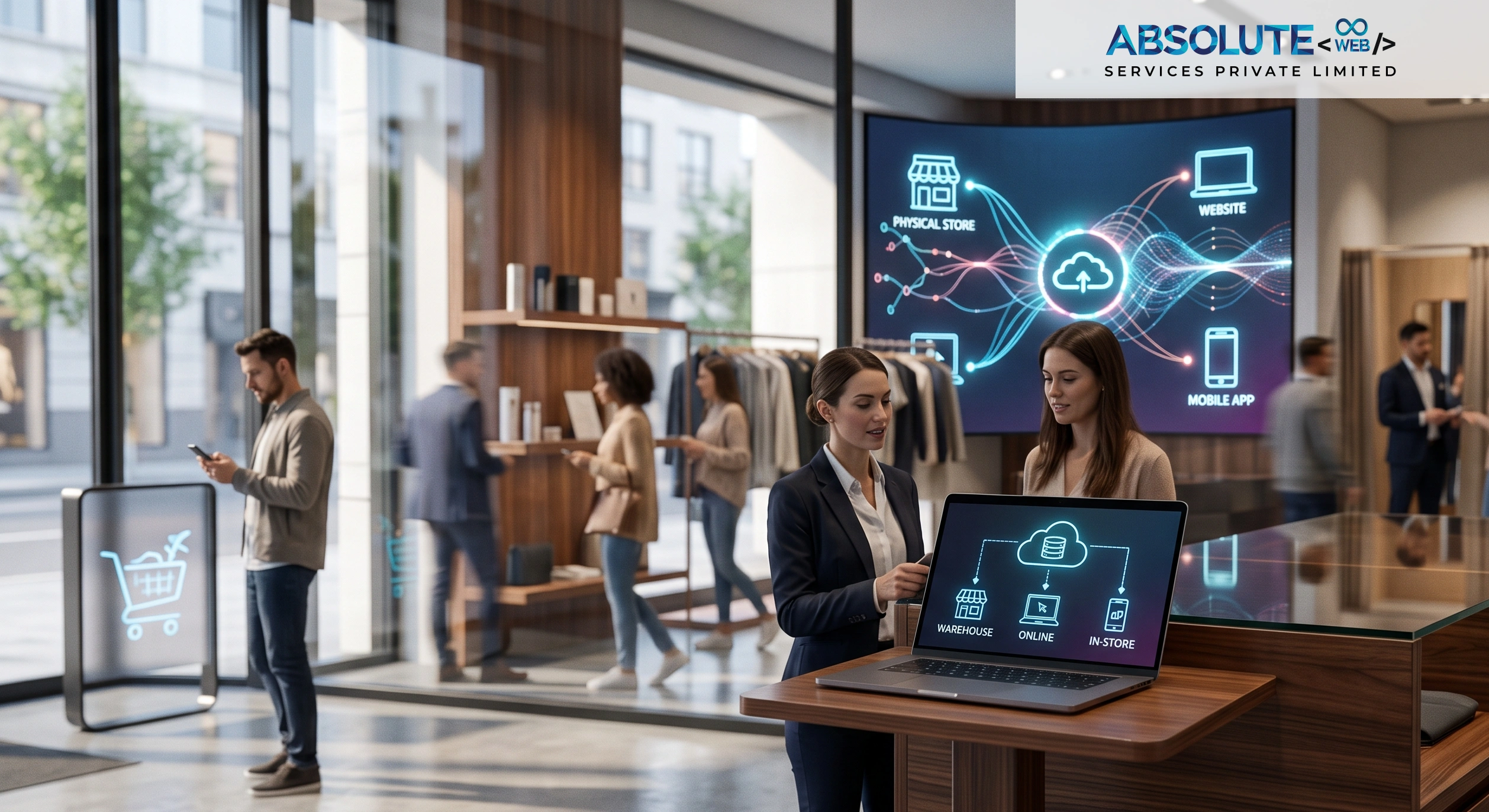
A custom ERP synchronizes physical retail stores, eCommerce websites, and third-party marketplaces. This guarantees a unified customer experience regarding product pricing, inventory availability, and order fulfillment across all touchpoints.
2. Real-Time Inventory Visibility
Monitor stock levels instantly across multiple warehouses and storefronts. This prevents costly stockouts, mitigates overstocking risks, and ensures highly accurate, timely automated replenishments.
3. Elevated Customer Experience & Retention
By aggregating loyalty data, purchase histories, and customer profiles into one CRM module, your team can deliver personalized product recommendations, swift support, and highly intuitive shopping journeys.
4. Analytics-Driven Decision Making
Custom retail ERPs offer dynamic dashboards compiling real-time finance, procurement, sales, and inventory data. This grants C-suite executives the insights required to deploy revenue-boosting strategies swiftly.
5. Automation-Led Cost Reductions
Eradicate manual data entry. Retail ERP software automates financial reporting, invoice generation, purchase order creation, and inventory adjustments, drastically cutting administrative overhead.
6. Infinite Scalability for Multi-Location Growth
Unlike rigid off-the-shelf software, a bespoke solution evolves with you. It seamlessly manages an unlimited number of suppliers, warehouses, sales channels, and physical stores from a single digital command center.
Must-Have Features in Your Retail ERP Solution
When engineering a modern digital retail platform, certain functionalities are non-negotiable. Ensure your retail ERP software development team includes these critical modules:
- Advanced Point of Sale (POS) Management: Handles payments, invoicing, discounts, and refunds while simultaneously syncing that data with your finance and inventory modules.
- Inventory & Warehouse Management: Automates stock replenishment, tracks warehouse movements, limits discrepancies, and drastically optimizes storage overhead costs.
- Omnichannel Integration: Connects customer data, order history, and live inventory across digital marketplaces, dedicated eCommerce sites, and brick-and-mortar stores.
- Integrated CRM: Logs customer feedback, communication history, and purchasing habits to boost customer lifetime value (CLV).
- Financial Management & Reporting: Consolidates general ledgers, cash flow analyses, tax data, and expense tracking under one roof.
- Supply Chain & Vendor Management: Optimizes supplier communications, procurement processes, delivery tracking, and purchase orders.
Retail ERP Software Development: An 8-Step Process
Building an enterprise-grade ERP requires partnering with an agency that deeply understands operational scalability. Here is the standard retail ERP software development roadmap:
- Analyze Business Requirements: Audit your existing operational bottlenecks and gather input from warehouse, sales, finance, and procurement stakeholders.
- Define Architecture and Modules: Select your foundation (Cloud, Hybrid, Custom, or On-Premise) and identify required modules (POS, CRM, Finance, etc.).
- Design User-Centric Interfaces: An intuitive UI boosts user adoption. Design role-specific dashboards tailored individually to your teams.
- Core Module Development: The coding phase where customized modules for order processing, finance, CRM, and POS are built.
- Third-Party Integrations: Utilize APIs to connect your new ERP with essential existing tools—such as logistics providers and payment gateways.
- Data Migration: Securely transition historical data (customers, inventory, finance) from legacy systems into the new ERP database.
- Rigorous Testing: Conduct thorough Quality Assurance (QA). Test security vulnerabilities, system performance, and POS reliability.
- Deployment & Training: Roll out the software (ideally in phases). Conduct extensive team training and optimize based on user feedback.
How Much Does Retail ERP Software Development Cost?
Development costs fluctuate based on the deployment model, module complexity, customization depth, and your development agency’s location. Here is a baseline estimate for a standard retail ERP software development project:
| Project Complexity | Ideal For | Core Features & Modules | Estimated Timeline | Estimated Cost (USD) |
|---|---|---|---|---|
| Basic ERP | Small Retailers | POS, Basic Sales Reporting, Simple Inventory | 3 – 5 months | $30,000 – $60,000 |
| Mid-Level ERP | Growing Retail Chains | POS, CRM, Finance, Analytics, Procurement, Inventory | 6 – 9 months | $60,000 – $150,000 |
| Enterprise ERP | Large Franchises | AI Forecasting, Custom Integrations, Multi-Warehouse | 9 – 18+ months | $150,000 – $500,000+ |
Overcoming Common Retail ERP Software Development Challenges
Every complex software project has hurdles. Here is how expert developers proactively solve them:
- Data Migration Errors: Solution: Perform rigorous data scrubbing prior to migration and execute the transfer in highly controlled phases.
- Legacy System Integration: Solution: Utilize an API-first architectural approach to guarantee seamless communication.
- Employee Resistance: Solution: Implement robust change management strategies and intuitive, role-based UI design.
- Omnichannel Sync Lags: Solution: Centralize the database architecture so data remains consistent in real-time across all platforms.
From Storefront to Back Office: Build Your Retail ERP with Absolute Web
Successful retail ERP software development goes far beyond writing code; it requires a profound understanding of how modern retail functions across digital marketplaces, massive warehouses, and neighborhood storefronts.
At Absolute Web, we merge deep retail domain expertise with elite engineering practices to deliver transformative custom ERP solutions. We simplify your operations to boost visibility and accelerate your capacity to scale.
Ready to unify your retail operations? Contact Absolute Web today to discuss your custom ERP project.