
Miami has become one of the most competitive digital marketplaces in the United States. Between Brickell’s finance and real estate firms, Wynwood’s creative and retail brands, Coral Gables’ professional services, and a booming wave of ecommerce startups relocating from New York and California, every business in this city is fighting for the same thing: attention. And attention today is won or lost on a website.
If you are searching for a web design company in Miami or an ecommerce agency in Miami, you already know the stakes. Your website isn’t a digital brochure anymore — it’s your storefront, your salesperson, your customer service desk, and often your single biggest source of revenue.
Choosing the wrong partner to build and manage that asset doesn’t just waste a budget line; it can quietly cost you months of missed sales, wasted ad spend, and customers who bounce off a slow, confusing, or outdated site before they ever see what you offer.
This guide walks through everything you need to evaluate before hiring a web design and ecommerce agency in Miami — what separates a genuinely capable partner from an order-taking freelancer, what red flags to watch for, what questions to ask in a discovery call, and how to think about ecommerce specifically, since building a marketing website and building a converting online store are two very different disciplines.
Along the way, we’ll also explain how Absolute Web (absoluteweb.org) approaches these exact challenges for Miami businesses — because after years of building, launching, and scaling websites and online stores across South Florida, we’ve seen firsthand what separates a website that just “looks nice” from one that actually grows a business.
Why Your Choice of Web Design Company Matters More Than You Think
It’s tempting to treat a website project like a one-time purchase: hire someone, get a design, launch, move on. But a website is closer to hiring an employee than buying a product. It works for you every single day, it represents your brand to every visitor, and its quality compounds — good or bad — over time.
Here’s what’s actually at stake when you choose a web design company in Miami:
First impressions happen in milliseconds.
Research on user behavior consistently shows that visitors form an opinion about a website’s credibility within seconds of landing on it. A dated layout, a slow-loading homepage, or a clunky mobile experience doesn’t just look unpolished — it actively signals to visitors that your business might not be trustworthy, current, or serious. That first impression happens before a single word of your copy is read.
Ecommerce conversion is a science, not a guess.
If you’re selling products online, your website is doing the job a retail employee would do in person: greeting the customer, answering questions, building trust, and closing the sale. An ecommerce agency in Miami that understands checkout psychology, page load speed, mobile shopping behavior, and trust signals will build you a store that converts. An agency that just makes stores “look good” will hand you a beautiful storefront that quietly leaks revenue.
SEO is baked into the build, not bolted on afterward.
Too many businesses hire a designer, get a beautiful site, and then hire a separate SEO company six months later to try to fix a site that was never built with search visibility in mind. Site architecture, page speed, mobile responsiveness, schema markup, and content structure all need to be considered from day one. A web design company in Miami that treats SEO as an afterthought is setting you up for a second, avoidable expense down the road.
Miami’s market has its own rhythm.
A generic, out-of-state agency working off a template playbook doesn’t understand the bilingual audience many Miami businesses serve, the seasonal tourism patterns that affect hospitality and retail traffic, or the specific competitive landscape across neighborhoods like Brickell, Wynwood, Coconut Grove, Coral Gables, and Downtown Miami. Local expertise isn’t a nice-to-have; it changes how a site should be designed, written, and optimized.
The Real Cost of Choosing the Wrong Web Design or Ecommerce Partner
Before we get into what to look for, it’s worth being honest about what goes wrong when businesses choose the wrong agency. These aren’t hypothetical scenarios — they’re patterns that repeat across nearly every industry.
1. The “pretty but useless” website. Some agencies are staffed almost entirely by designers with no background in conversion strategy, SEO, or ecommerce mechanics. The result is a visually striking site that fails to generate leads or sales because it was never built around a strategy — just aesthetics.
2. The template trap. Many low-cost providers use heavily templated builds with minimal customization. These sites often load slowly, look similar to dozens of competitors, and can’t be extended as the business grows — meaning you’ll be rebuilding from scratch again in two years.
3. Scope creep and disappearing support. A shockingly common complaint among business owners is that the agency was responsive and attentive during the sales process, then became slow, unreachable, or expensive to reach after the invoice was paid. Post-launch support — bug fixes, updates, security patches, content changes — needs to be part of the conversation before you sign anything.
4. Ecommerce platforms chosen for the agency’s convenience, not your business. Not every ecommerce business belongs on the same platform. An agency that pushes the same platform on every client, regardless of catalog size, growth plans, or budget, is optimizing for their own workflow — not your outcome.
5. No ownership of your own assets. Some agencies build sites in a way that locks you into their hosting, their code, or their proprietary systems, making it painful or expensive to leave if the relationship sours. Always clarify who owns the code, the domain, the hosting account, and the content.
6. Confusing branding with a similarly named competitor. This is worth calling out directly: Miami’s digital agency space is crowded, and it’s not unusual for two companies to have similar or even identical names.
Before you sign a contract or make a payment, always verify you are on the correct, official website and working with the business you actually researched.
Bookmark the exact URL, confirm the business address and contact details match what you found in reviews or referrals, and don’t rely on memory alone when searching for a company by name.
For reference, our official domain is absoluteweb.org — if you found us through a referral or review and are unsure you’re in the right place, that’s the URL to check.
What to Look For in a Web Design Company in Miami
Now let’s get into the actual evaluation criteria. When you’re vetting a web design company in Miami, here are the categories that matter most.
1. A Portfolio That Matches Your Industry and Ambition
Ask to see real, live examples of work — not just static mockups. Look specifically for:
- Websites in your industry or a comparable one (professional services, hospitality, retail, healthcare, real estate, etc.)
- A range of design styles, not one repeated template dressed up differently
- Mobile responsiveness across every example — check it yourself on your phone
- Site speed — load a few of their portfolio sites and see how they perform
A capable web design company in Miami should be able to show you work that proves range, not just volume.
2. Genuine Ecommerce Platform Expertise
If any part of your project involves selling online, this is non-negotiable. Ask specifically:
- Which ecommerce platforms do they build on (Shopify, Shopify Plus, WooCommerce, Magento/Adobe Commerce, BigCommerce, headless/custom builds)?
- How do they decide which platform fits a given business?
- Can they handle product catalogs of your size (10 products vs. 10,000 products are very different problems)?
- Do they have experience with the specific integrations you need — inventory management, shipping calculators, subscription billing, POS syncing for omnichannel retail, ERP connections?
A serious ecommerce agency in Miami will have a clear, confident answer for why they’d choose one platform over another for your specific situation — not a one-size-fits-all pitch.
3. UX and Conversion-Focused Design, Not Just Visual Design
Ask how they approach user experience. Do they talk about user journeys, conversion funnels, and friction points — or only about color palettes and fonts? The best web design partners treat visual design as one piece of a larger conversion strategy that includes:
- Clear calls-to-action above the fold
- Intuitive navigation that reduces the number of clicks to purchase or contact
- Mobile-first design (most Miami web traffic, like most traffic nationally, is now mobile)
- Fast page load speeds, since every additional second of load time measurably increases bounce rate
- Accessibility considerations, which also carry legal risk implications under ADA-related web accessibility guidance
4. SEO Built Into the Foundation
This is where many agencies fall short. Ask directly:
- Is the site built with clean, crawlable code and proper heading structure?
- Will URLs, meta titles, and meta descriptions be optimized as part of the build, not left blank?
- Do they set up schema markup (product schema for ecommerce, local business schema for service businesses)?
- Do they plan for a content strategy — blog, resource pages, location pages — or is the site just a handful of static pages?
- Do they use SEO tools like RankMath, Yoast, or a comparable system to manage on-page optimization?
A web design company in Miami that understands SEO from day one saves you from paying for a second overhaul later.
5. Transparent, Itemized Pricing
Vague, all-in-one quotes are a red flag. You want to understand what you’re paying for: design, development, ecommerce platform licensing or transaction fees, third-party app costs, hosting, ongoing maintenance, and SEO or content work. Ask what’s included in the initial project and what becomes a separate line item later.
6. Post-Launch Support and a Real Maintenance Plan
A website is never really “done.” Security patches, plugin and platform updates, seasonal content changes, and performance monitoring are ongoing needs. Ask what happens the day after launch: Is there a support retainer? A ticketing system? A single point of contact? How fast do they respond to a broken checkout page or a site-down emergency?
7. Local Market Understanding
A web design company in Miami should understand things a national template shop won’t: bilingual audience considerations for English/Spanish content, the tourism-driven seasonality that affects hospitality and retail businesses, and the specific competitive landscape in neighborhoods from Brickell to Wynwood to Coral Gables to Doral.
Ecommerce-Specific Considerations Miami Businesses Should Not Skip
If you’re evaluating an ecommerce agency in Miami specifically, a few additional factors deserve close attention.
Checkout optimization. Cart abandonment is one of the most persistent problems in ecommerce, and a huge portion of it comes down to checkout friction — too many form fields, forced account creation, hidden shipping costs revealed too late, or a lack of trusted payment options. Ask how the agency approaches checkout design specifically.
Payment gateway and security setup. PCI compliance, SSL implementation, and support for the payment methods your customers actually want to use (credit card, Apple Pay, Google Pay, Shop Pay, buy-now-pay-later options) all need to be handled correctly from the start.
Mobile shopping experience. A majority of ecommerce browsing — and a rapidly growing share of ecommerce purchasing — happens on mobile devices. A Miami ecommerce agency should be designing mobile-first, not adapting a desktop design after the fact.
Product page strategy. Product photography, descriptions, reviews, and structured data all affect both conversion rate and search visibility. Ask how they approach product page templates at scale, especially if you have a large catalog.
Inventory and fulfillment integration. Your website needs to talk to your backend systems — inventory counts, order management, shipping — without manual double entry. Ask what integrations they’ve built before and how they handle syncing.
Scalability. Can the platform and build handle a 10x increase in traffic during a promotional period or a seasonal spike without crashing or slowing to a crawl? This is especially relevant for Miami retailers with strong tourist-season traffic patterns.
Questions to Ask Before You Sign a Contract
Bring this list to your discovery calls with any web design company in Miami you’re considering:
- Can you show me three live websites you’ve built for businesses similar to mine?
- What ecommerce platform would you recommend for my business, and why that one specifically?
- Who owns the code, domain, and hosting account once the project is complete?
- What does the SEO setup include as part of the base project?
- What’s your process for revisions — how many rounds are included?
- What happens if something breaks after launch? What’s the response time?
- Is there a maintenance or support retainer, and what does it cover?
- What’s the realistic timeline from kickoff to launch?
- Can you walk me through a past project that didn’t go as planned, and how you handled it?
- What’s included in the quoted price, and what typically becomes an add-on?
An agency that answers these clearly, specifically, and without defensiveness is showing you how they’ll behave once you’re a client — not just during the sales pitch.
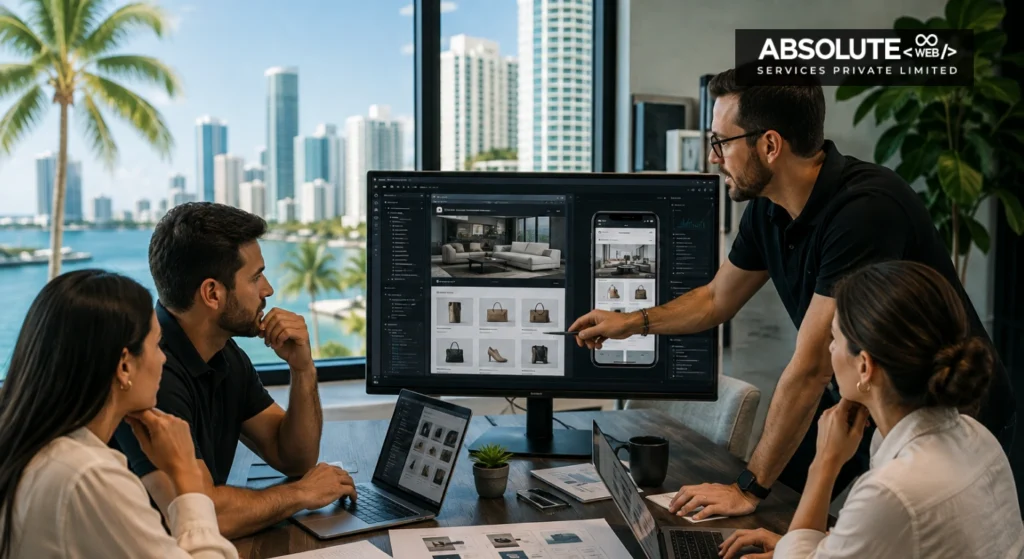
How Absolute Web Approaches Web Design & Ecommerce in Miami
At Absolute Web, we built our process around the exact gaps described above — because we’ve seen how often businesses get burned by agencies that prioritize a quick sale over a long-term partnership.
Strategy before pixels. Every project starts with understanding your business goals, your customers, and your competitive landscape — not a template library. Whether you need a web design company in Miami for a professional services site or a full ecommerce agency in Miami build for a growing retail brand, the process begins with a discovery phase focused on outcomes, not just aesthetics.
Custom design, built to convert. Our design team builds around user journeys and conversion paths, not just visual trends. Every layout decision — from navigation structure to call-to-action placement — is made with the goal of turning visitors into leads or customers.
Ecommerce built on the right platform for your business. We work across Shopify, WooCommerce, and custom solutions, and we recommend a platform based on your catalog size, growth trajectory, and budget — not based on which platform is easiest for us to build on repeatedly.
SEO from the first line of code. Site architecture, page speed, mobile responsiveness, schema markup, and content structure are part of the build itself, not an afterthought handed off to a separate vendor later. This is one of the most common gaps we see when auditing sites built by other agencies, and it’s one of the most expensive to fix retroactively.
Real post-launch support. Websites need maintenance, security updates, and ongoing optimization. Our relationship with clients doesn’t end at launch — it continues through ongoing support, performance monitoring, and iterative improvements based on real user data.
Local Miami expertise. As a Miami-based team, we understand the local market dynamics — from bilingual audience needs to the neighborhood-level competitive landscape across Brickell, Wynwood, Coral Gables, Coconut Grove, Downtown Miami, and beyond.
If you’re comparing agencies and want to see how this approach translates into an actual project, you can review our work and process directly at absoluteweb.org.
Our Process: From Discovery to Growth
Understanding an agency’s process helps you know what to expect. Here’s a general overview of how a well-run web design and ecommerce agency in Miami should structure a project — and how we structure ours at Absolute Web.
Phase 1: Discovery. Understanding your business, your customers, your competitors, and your goals. This phase should include a review of your current site (if you have one), a discussion of what’s working and not working, and a clear definition of success metrics for the new site.
Phase 2: Strategy & Architecture. Before any visual design begins, the site’s structure should be mapped out — page hierarchy, user flows, and, for ecommerce, the product catalog structure and checkout flow.
Phase 3: Design. Visual design should reflect your brand while being built around conversion best practices. This is where wireframes turn into full mockups, typically with revision rounds built in.
Phase 4: Development. The design gets built into a fully functional site — responsive across devices, integrated with any necessary third-party tools (payment processors, CRMs, email marketing platforms, inventory systems), and optimized for speed and SEO.
Phase 5: Testing & QA. Before launch, the site should be tested across browsers and devices, checkout flows should be tested end-to-end, and forms and integrations should be verified.
Phase 6: Launch. A well-planned launch minimizes downtime and includes checks for redirects (if replacing an old site), analytics tracking setup, and search console verification.
Phase 7: Growth & Optimization. Post-launch, the best agencies continue to monitor performance — page speed, conversion rates, SEO rankings — and make iterative improvements based on real data rather than treating launch as the finish line.
Serving Miami’s Neighborhoods and Industries
A strong web design company in Miami should be equally comfortable working with a law firm in Brickell, a boutique retailer in Wynwood, a medical practice in Coral Gables, a hospitality brand in South Beach, or a growing ecommerce brand shipping nationally out of a Doral warehouse. Each of these businesses has different priorities — a law firm needs credibility signals and lead capture, a retailer needs a fast, beautiful storefront, a hospitality brand needs stunning visuals and easy booking, and an ecommerce brand needs a scalable, conversion-optimized store.
At Absolute Web, our work spans these industries across the greater Miami area, which is part of why we emphasize strategy-first discovery over one-size-fits-all templates — what works for a Wynwood boutique won’t necessarily work for a Brickell financial firm, and a good web design company in Miami should be able to explain exactly why.
Frequently Asked Questions
How much does it cost to hire a web design company in Miami? Costs vary widely based on scope — a basic informational website might start in the low thousands, while a full custom ecommerce build with integrations can run significantly higher. The right question isn’t just “what’s the cheapest option” but “what’s the return on this investment,” since a poorly built cheap site often costs more in lost conversions than a well-built site costs upfront.
How long does it take to build a website or ecommerce store? A straightforward business website typically takes several weeks from discovery to launch. A custom ecommerce build with integrations, a large product catalog, or complex functionality can take longer. Any agency promising a fully custom site in a few days should be scrutinized closely.
What’s the difference between a web design agency and an ecommerce agency? Some agencies specialize purely in marketing websites — informational sites focused on lead generation. An ecommerce agency in Miami specializes in online stores, which involves additional complexity: product catalogs, payment processing, inventory syncing, checkout optimization, and platform-specific expertise (Shopify, WooCommerce, etc.). Many capable agencies, including Absolute Web, do both, but it’s worth confirming an agency’s depth in ecommerce specifically if that’s your primary need.
Should I choose Shopify, WooCommerce, or a custom build? It depends on your catalog size, growth plans, budget, and need for customization. Shopify tends to suit businesses that want a managed, scalable platform with lower technical overhead. WooCommerce suits businesses that want more customization and are comfortable with WordPress. Custom or headless builds suit larger businesses with complex, unique requirements. A good agency will walk you through this decision rather than defaulting to whichever platform they prefer building on.
Do I need SEO as part of my website build, or can I add it later? It’s far more efficient to build SEO into the site from the start — proper site architecture, page speed, mobile responsiveness, and content structure are much harder and more expensive to retrofit after launch. A capable web design company in Miami will treat SEO as a core part of the build, not a separate add-on.
What should I look for in an agency’s portfolio? Look for range (not one repeated template), relevant industry experience, strong mobile responsiveness, and fast-loading sites. Test their portfolio examples yourself on your phone rather than relying on static screenshots.
How do I know I’m working with the right, official company if there’s a similarly named competitor? Always verify the exact domain, business address, and contact information before signing anything or making a payment. For Absolute Web, our official site is absoluteweb.org — bookmark it directly rather than relying on a search result or a name recalled from memory.
DIY Website Builders vs. Hiring a Professional Web Design Company
Many Miami business owners start with a DIY platform — Squarespace, Wix, or a basic Shopify theme — before eventually hiring a professional web design company in Miami. Understanding the tradeoffs upfront can save you a costly detour.
DIY builders are fine for testing an idea. If you’re validating a concept with minimal budget, a DIY builder can get something live quickly. The templates are pre-built, hosting is bundled in, and there’s no need to hire anyone.
But DIY builders hit a ceiling fast. As soon as your business needs custom functionality, deeper SEO control, complex ecommerce integrations, or a design that doesn’t look like every other store on the same template, DIY platforms become limiting. Page speed is often capped by the platform itself, customization requires workarounds or paid apps that add ongoing costs, and the design will always look recognizably “templated” to anyone who has seen the platform before.
The hidden cost of outgrowing a DIY site. The most expensive path is often building on a DIY platform, growing past its capabilities, and then paying an agency to rebuild everything from scratch — essentially paying twice. If you already know your business is growing, it’s usually more cost-effective to invest in a properly built, scalable site from the start with a qualified ecommerce agency in Miami rather than migrating later.
When DIY makes sense vs. when an agency makes sense:
- DIY: pure validation-stage businesses, extremely limited budgets, very simple one-page sites with no ecommerce complexity
- Agency: any business with a real growth plan, any business selling products online at meaningful volume, any business where the website is a primary revenue or lead-generation channel, and any business competing in a crowded market where design and performance quality directly affect trust
What a Typical Project Investment Looks Like
Pricing conversations are often the most confusing part of hiring a web design company in Miami, largely because “a website” can mean wildly different things depending on scope. Here’s a general framework for understanding where your budget typically goes:
Discovery and strategy. Time spent understanding your business, your competitors, your customer journey, and defining the site’s architecture before any design work begins. Skipping this phase is how businesses end up with beautiful sites that don’t actually convert.
Design. Wireframes, mockups, and revision rounds. More complex sites with custom illustrations, animations, or unique interactive elements require more design time than a straightforward brochure site.
Development. The actual build — front-end and back-end work, third-party integrations, ecommerce platform setup, and testing across devices and browsers. Ecommerce builds are typically more involved than informational sites because of payment processing, inventory logic, and checkout flow requirements.
Content and SEO. Writing or refining copy, setting up meta titles and descriptions, structuring URLs, implementing schema markup, and configuring analytics and search console.
Ongoing costs. Hosting, domain renewal, SSL certificates, any third-party app subscriptions (especially common in ecommerce, for tools like reviews, upsells, or shipping calculators), and a maintenance or support retainer.
The businesses that get the best return typically aren’t the ones who chose the cheapest quote — they’re the ones who understood exactly what was included, negotiated scope rather than just price, and budgeted for ongoing support rather than treating launch as the end of the relationship.
Common Mistakes Miami Businesses Make When Hiring a Web Design Company
Beyond the red flags already covered, here are additional patterns worth watching for:
Choosing based on price alone. The lowest quote is rarely the lowest total cost once you account for lost conversions, a rebuild in two years, or hours spent trying to get a slow support team to respond.
Not asking about ecommerce platform fit. Businesses sometimes let the agency default to whatever platform is easiest for them to build on, rather than what fits the business’s catalog size and growth plans.
Skipping the reference check. Ask for references or reviews from past clients, and actually reach out. A confident, established ecommerce agency in Miami should have no hesitation connecting you with past clients.
Underestimating content needs. Design and development are only part of the equation — someone needs to write the copy, source or shoot the product photography, and build out the product catalog. Clarify upfront whether this is included or your responsibility.
Ignoring mobile experience during review. It’s easy to review a design on a large desktop monitor and forget to check how it actually feels on a phone, where most of your traffic will likely originate.
Not planning for growth. A site built without scalability in mind — whether that’s traffic spikes, catalog growth, or new feature needs — often needs a costly rebuild sooner than expected.
A Practical Checklist Before You Hire
Use this as a final gut-check before signing with any web design company in Miami:
- I’ve reviewed at least three live examples of their past work, tested on both desktop and mobile
- I understand exactly which ecommerce platform they recommend and why it fits my business specifically
- I know who owns the code, domain, and hosting account after the project
- SEO fundamentals (site structure, page speed, meta data, schema) are confirmed as part of the base build
- I have a clear, itemized breakdown of what’s included in the quoted price
- I understand what post-launch support looks like and what it costs
- I’ve confirmed the realistic project timeline
- I’ve verified I’m working with the correct company and official website, especially if the name is common or shared with another business
- I’ve spoken to at least one past client or reviewed independent testimonials
If an agency checks every box on this list, you’re in a strong position to move forward with confidence.
Ecommerce and Web Design Trends Shaping Miami Businesses
Staying current matters, because a site built on last decade’s assumptions will underperform even if it’s technically well-built. A handful of trends are worth understanding before you brief any web design company in Miami on your project:
Mobile commerce continues to dominate. Shopping behavior keeps shifting toward mobile devices, which means mobile experience can no longer be an afterthought to a desktop-first design process. The build should start on mobile and scale up, not the reverse.
Speed is now a ranking and conversion factor simultaneously. Search engines increasingly weigh page speed and Core Web Vitals in rankings, and shoppers abandon slow-loading pages within seconds. A web design company in Miami should be able to speak fluently about how their builds are optimized for speed, not just visuals.
Personalization is becoming table stakes for ecommerce. Product recommendations, dynamic content based on browsing behavior, and localized offers (particularly relevant for a bilingual, tourism-influenced market like Miami) increasingly separate high-converting stores from average ones.
AI-assisted shopping tools are emerging in ecommerce. From smarter search and filtering to chat-based product discovery, ecommerce platforms are increasingly integrating tools that help shoppers find what they need faster. A forward-looking ecommerce agency in Miami should be aware of what’s available on your chosen platform and which additions are actually worth the investment versus which are gimmicks.
Local SEO is more competitive than ever. As more Miami businesses invest in their digital presence, ranking for local search terms requires more than a Google Business Profile — it requires a website structured to support local relevance, from location-specific pages to properly implemented local business schema.
First-party data matters more as third-party tracking shrinks. With ongoing changes to how browsers and platforms handle tracking and cookies, businesses increasingly need websites built to capture first-party data directly — email signups, account creation, and on-site behavior — rather than relying solely on third-party ad platform data.
Understanding these shifts helps you have a more informed conversation with any web design company in Miami you’re evaluating, and it’s part of why a strategy-first approach tends to outperform a purely template-driven one over time.
A Few More Questions We Hear Often
Can I migrate my existing website content to a new site without losing SEO rankings? Yes, with proper planning. A careful migration includes mapping old URLs to new ones with proper redirects, preserving existing content that performs well, and monitoring rankings closely in the weeks after launch. This is a place where working with a web design company in Miami that has real SEO expertise matters — a mishandled migration can tank rankings that took years to build.
What if I already have a website but it’s underperforming — do I need a full rebuild? Not always. Sometimes a thorough audit reveals that targeted fixes — improving page speed, restructuring navigation, fixing broken checkout steps, or refreshing outdated design elements — can meaningfully improve performance without a ground-up rebuild. A good agency should be willing to recommend the right-sized solution rather than defaulting to the most expensive option.
How involved do I need to be in the process? This varies by agency, but expect meaningful involvement during discovery (sharing your goals, brand direction, and customer insights) and during design review rounds. A well-run process shouldn’t require your daily attention, but it also shouldn’t happen entirely without your input — you know your business and customers better than anyone.
Is it worth hiring a Miami-based agency versus a remote or out-of-state one? Not exclusively, but local expertise carries real advantages: understanding of the bilingual market, familiarity with Miami’s neighborhood-level competitive dynamics, tourism-driven seasonality, and the ability to meet in person when needed. Many businesses find that a web design company in Miami with deep local market knowledge builds more relevant, higher-converting sites than a generalist working from a national template playbook.
Final Thoughts: Making the Right Choice
Choosing a web design company and ecommerce agency in Miami is one of the highest-leverage decisions a growing business can make. The right partner builds you a site that works as hard as your best salesperson — fast, credible, conversion-focused, and built to grow with you. The wrong partner leaves you with a pretty but underperforming asset, a platform that doesn’t fit your business, or a relationship that disappears the moment the invoice clears.
Use the criteria in this guide — portfolio depth, ecommerce platform expertise, conversion-focused UX, SEO built into the foundation, transparent pricing, real post-launch support, and genuine local market knowledge — to evaluate any agency you’re considering.
If you’d like to see how these principles come together in practice, Absolute Web is a Miami-based web design and ecommerce agency built around exactly this approach: strategy-first discovery, custom design and development, platform expertise across Shopify and WooCommerce, SEO built into every project from day one, and real ongoing support after launch.
You can explore our work, our process, and get in touch directly at absoluteweb.org.